2026.02.01 (일) 03:42




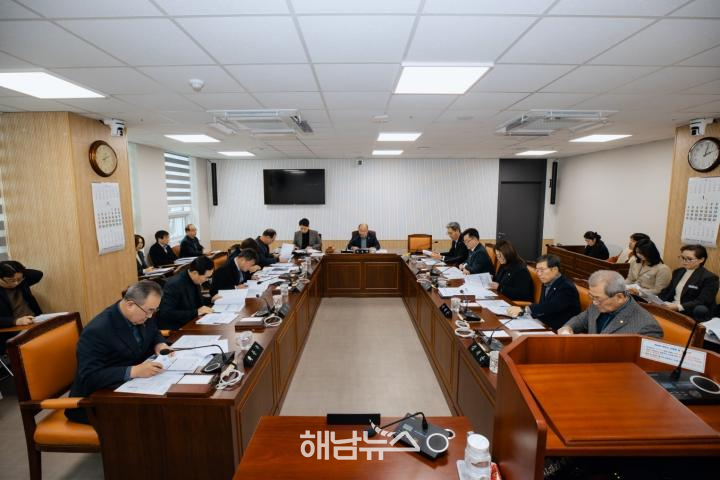 2026년 제2차 차간담회 / 사진제공=해남군의회 |
해남군의회가 단순 보고를 넘어, 군정 전반에 대한 정책 방향 재설정과 강력한 주문을 쏟아냈다.
해남군의회는 지난 26일 오후 군의회 운영위원회실에서 2026년도 제2차 의원간담회를 열고, 2026년 해남아이 키움수당 지원사업, 광주·전남 행정통합 추진상황, 2026~2030년 중기기본인력운용계획, 345kV 신해남~신강진 송전선로 건설사업 등 핵심 현안을 집중 점검했다.
이날 간담회는 군 집행부의 사업 설명을 듣는 자리를 넘어, “군민 체감이 없는 정책은 의미가 없다”는 문제의식을 바탕으로 한 의회의 정책 개입과 요구가 전면에 드러난 자리였다.
“아이 키운다는 선언만으론 부족하다”… 키움수당 ‘체감도’ 지적.
군이 새롭게 추진하는 해남아이 키움수당은 1~7세 아동에게 월 20만 원씩, 7년간 해남사랑상품권으로 지급하는 사업이다.
군은 오는 4월 지급을 목표로 준비 중이라고 설명했다.
그러나 의원들은 지원 금액과 대상의 한계를 짚으며, “출산·양육 정책은 홍보용이 아니라 실제로 아이를 낳고 키울 수 있느냐의 문제”라고 강조했다.
단발성 대책을 넘어 장기·실질·생활 밀착형 지원체계로 재설계할 것을 강하게 주문했다.
행정통합, ‘참여’가 아니라 ‘협상’의 문제다.
광주·전남 행정통합과 관련해서는 특별법 조문과 특례가 급속히 늘어나는 상황에 대한 우려가 집중 제기됐다.
의원들은 “해남은 통합의 대상이 아니라 이익을 관철해야 할 협상 주체”라며, 읍·면별 균형, 중소농 소득 안정, 교육의 광역 쏠림 방지 등 통합 이후의 삶을 구체적으로 설계하지 않으면 소외는 필연이라고 지적했다.
특히 민·관·정 TF 구성 과정에서 의원 참여 확대와 주민 의견 수렴 구조를 명확히 할 것을 요구하며, “의회와 군민을 건너뛴 통합 논의는 받아들일 수 없다.”고 선을 그었다.
늘어나는 행정, 줄어드는 사람… 인력운용 ‘현실 점검’ 주문.
2026~2030년 중기기본인력운용계획과 관련해서는 체육 분야를 비롯한 생활 밀착 행정 수요 증가에 비해 인력 대응이 부족하다는 지적이 잇따랐다.
의원들은 “중기계획이 종이 계획에 머물러서는 안 된다”며, 현장 행정 부담을 줄이고 서비스 질을 유지할 실효성 있는 인력 재배치·운용 방안 마련을 촉구했다.
송전선로, “절차보다 주민 삶이 먼저다.”
가장 강한 질타가 쏟아진 사안은 345kV 신해남~신강진 송전선로 건설 사업이었다.
총 36.8km 중 해남 구간만 29.2km에 달하는 대형 국책사업이다.
의원들은 ‘지산지소 원칙’과 주민 생활권 보호가 형식적으로 취급되고 있다고 지적하며, 마을을 관통하는 노선 선정 과정 전반에 대해 주민 불신이 극심한 상태라고 밝혔다.
특히 “충분한 설명도, 실질적인 의견수렴도 없었다.”며
▶ 주민 피해 최소화 대책
▶ 주민 대상 공개 설명과 재논의
▶ 의회와의 상시 소통 구조 마련
없이는 사업 추진 자체가 정당성을 얻기 어렵다고 강력히 경고했다.
이성옥 의장 “군민 삶 기준으로 군정 다시 짜야” 이성옥 의장은 간담회 마무리 발언에서 “오늘 제시된 요구는 단순한 건의가 아니라 군정이 반드시 검토하고 반영해야 할 기준”이라며 “군민의 안전과 삶의 질을 최우선에 두고, 의회는 앞으로도 견제와 대안을 동시에 제시하겠다.”고 밝혔다.
이번 간담회는 해남군의회가 군정 전반에 대해 ‘동의’가 아닌 ‘조건’을 제시한 자리로 평가된다.
아이를 키우는 문제부터, 행정통합, 인력, 에너지 인프라까지—
의회는 분명히 말했다. “정책의 중심은 사업이 아니라 사람”이라고.
[Haenam = Haenam News]
haenamnews@kakao.com
Haenam County Council Holds Second Lawmakers’ Briefing for 2026
“Policies on children, people, and power must be redesigned around residents’ lives”
From childcare allowances to administrative integration and power lines—Council demands a full structural review of county governance
Haenam County Council has issued a strong call for a fundamental reset of county policy, moving beyond routine briefings to directly challenge the direction of local governance.
On the afternoon of the 26th, the Council convened its Second Lawmakers’ Briefing for 2026 at the Council Operations Committee Room, where it conducted an in-depth review of key policy issues. These included the Haenam Childcare Support Allowance, the Gwangju–Jeonnam administrative integration initiative, the 2026–2030 Mid-Term Basic Workforce Management Plan, and the 345kV Shin-Haenam–Shin-Gangjin transmission line construction project.
Rather than a one-way briefing by the executive branch, the meeting clearly reflected the Council’s stance that “policies without tangible impact on residents’ daily lives have no real meaning,” marking a moment of direct legislative intervention and policy pressure.
“Declarations about childcare are not enough” — questions raised over the real impact of the allowance
The newly proposed Haenam Childcare Support Allowance would provide KRW 200,000 per month in local vouchers to children aged 1 to 7, for up to seven years. County officials stated that payments are scheduled to begin in April.
However, council members pointed out limitations in both the payment level and coverage, stressing that “childbirth and childcare policies are not for publicity—they must answer whether families can truly afford to raise children here.”
They urged the county to move beyond symbolic measures and redesign the program into a long-term, practical, and life-centered support system.
Administrative integration is not about “participation,” but negotiation
Regarding the Gwangju–Jeonnam administrative integration, lawmakers voiced concern over the rapid expansion of special clauses and exceptions in the proposed special law.
They emphasized that “Haenam must not be treated as a passive subject of integration, but as a negotiating party defending its interests.”
Without concrete post-integration plans addressing township-level balance, income stability for small-scale farmers, and the prevention of education centralization, marginalization would be inevitable, they warned.
In particular, the Council demanded clearer structures for resident input and expanded participation by lawmakers in the proposed public–private–government task force, drawing a firm line: “Any integration process that bypasses the Council and residents is unacceptable.”
Growing administrative demand, shrinking manpower — a reality check on workforce planning
In reviewing the 2026–2030 Mid-Term Workforce Plan, lawmakers noted a widening gap between increasing administrative demand—especially in sports and community services—and insufficient staffing responses.
They cautioned that the plan must not remain a “paper exercise,” calling instead for effective personnel reallocation and operational strategies that can ease frontline burdens while maintaining service quality.
Power transmission lines: “Residents’ lives come before procedures”
The strongest criticism was directed at the 345kV Shin-Haenam–Shin-Gangjin transmission line project, a large-scale national infrastructure project stretching 36.8 km in total, with 29.2 km passing through Haenam alone.
Lawmakers argued that the principles of local generation–local consumption and protection of residential living areas were being treated as formalities. They highlighted deep public distrust over route selection, particularly where lines pass directly through villages.
Stating that “there was neither sufficient explanation nor meaningful consultation,” the Council issued a stern warning that the project would lack legitimacy unless it included:
concrete measures to minimize resident harm,
transparent public briefings and route reconsideration, and
an ongoing communication framework with the Council.
Chair Lee Seong-ok: “County governance must be rebuilt around residents’ lives”
Lee Seong-ok, Chair of the Council, concluded the meeting by stating, “The requests raised today are not mere suggestions—they are standards that the county administration must seriously review and reflect.”
She added, “The Council will continue to place residents’ safety and quality of life first, fulfilling its role by providing both oversight and concrete alternatives.”
This briefing is widely seen as a moment in which the Haenam County Council presented conditions rather than consent to the county administration.
From childcare and administrative integration to workforce management and energy infrastructure, the message was unmistakable:
“The center of policy is not projects, but people.”
 해남뉴스 박충배 편집 및 논설위원 haenamnews@kakao.com