| 13년 걸리던 송전망을 끌어내린다. 한전, ‘에너지고속도로’ 전면 가동… 재생에너지·AI 시대 전력망 대전환 선언 해남뉴스 박충배 편집 및 논설위원 haenamnews@kakao.com |
| 2026년 01월 28일(수) 11:13 |
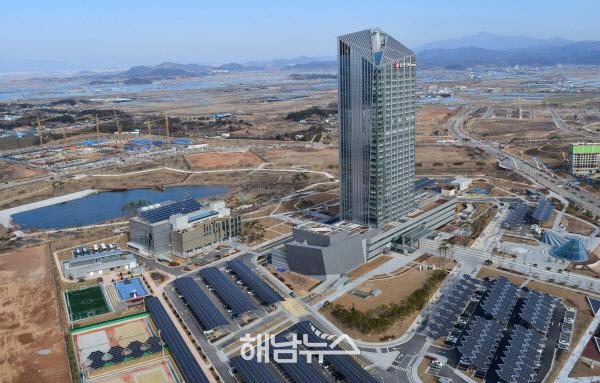 빛가람도시 한국전력공사 전경 / 사진제공=한국전력공사 |
풍력·태양광 중심의 재생에너지 대전환과 반도체·인공지능(AI) 등 첨단산업 확대로 전력 수요가 급증하는 가운데, 한국전력이 ‘13년 걸리던 송전망 건설 구조를 허물고’ 국가 전력망을 적기에 구축하겠다는 강한 의지를 천명했다.
한국전력공사는 지난 27일 나주시 빛가람동 본사에서 ‘K-그리드 신속 구축 전략 대토론회’를 열고, 재생에너지 중심의 에너지 대전환을 뒷받침할 국가 전력망 제도·기술 혁신 마스터플랜을 공개했다.
핵심은 전력망 건설 시간을 대폭 단축해 ‘에너지고속도로’를 가속화하는 것이다.
재생에너지는 호남에, 수요는 수도권에… 해법은 ‘초고속 전력망’ 정부와 한전은 재생에너지 자원이 풍부한 호남권과 전력 수요가 집중되는 수도권을 신속·안정적으로 연결하는 것이 국가 경쟁력의 관건이라고 판단했다.
특히 AI·반도체 등 전력 집약적 산업의 성장으로 전력 수요가 폭증하는 상황에서, 재생에너지 접속 대기 해소와 안정적 전력 공급은 더 이상 미룰 수 없는 과제로 떠올랐다.
이에 따라 한전은 행정절차 지연과 주민 갈등으로 장기화된 전력망 건설 사업을 전면 재검토하고, 산·학·연 전문가로 구성된 전담 태스크포스(TF)를 가동해 제도와 기술을 동시에 혁신한다는 전략을 제시했다.
제도 혁신 7개, 기술 혁신 11개… 총 18개 과제 추진 마스터플랜은 제도 혁신 7개, 기술 혁신 11개 등 총 18개 핵심 과제로 구성됐다.
제도 혁신 분야에서는 송전 건설 시공자원(자재·인력) 확보 전략 수립, 지중 송전선로 경과지 선정 절차 개선, 지중 송전 기자재 신규 공급망 확보, 설계·시공 일괄 계약 제도 도입, 고속도로 유휴부지 내 변전소 입지 활용, 지자체 인허가 절차 개선 등이 제시됐다.
기술 혁신 분야에서는 전력 케이블 지상 설치 공법 개발, 하천 횡단 수저(수중) 케이블 포설 공법 개발, 1.5GW급 대용량 케이블 개발, 터널공법을 대체할 신공법 개발, 송전 용량 증대 기술 개발 등이 포함됐다.
이를 통해 공사 기간을 획기적으로 줄이고, 동시다발적인 대규모 전력망 구축을 가능하게 한다는 구상이다.
2028년 호남 재생에너지 연계 전력망 ‘동시다발 착수’
한전은 2028년을 목표로 호남지역 재생에너지 연계를 위한 대규모 전력망 사업을 동시다발적으로 착수할 계획이다.
최근 자재·인력 부족으로 인한 사업 지연 가능성을 차단하기 위해, 사전 시공자원 확보 전략도 병행 추진한다.
이날 토론회에서 김동철 한전 사장은 “첨단산업 확대에 따른 전력 공급과 재생에너지 접속 대기 해소는 국가 경제 경쟁력과 직결된 중대 과제”라며 “송전망 평균 건설 기간 13년이라는 구조적 한계를 허물고, 에너지고속도로를 적기에 구축하겠다.”고 강조했다.
‘전력망이 곧 산업 경쟁력’
이번 마스터플랜은 단순한 전력 인프라 확충을 넘어, 재생에너지·AI·반도체로 이어지는 국가 산업 전략의 기반을 재설계하겠다는 선언으로 읽힌다.
전력망이 늦어 산업이 멈추는 시대는 끝내고, 전력망이 산업 성장을 앞서 견인하는 구조로의 전환. K-그리드 신속 구축 전략이 실제 현장에서 얼마나 빠르게 구현될지, 그 성패가 대한민국 에너지 대전환의 속도를 가를 전망이다.
[Jeonnam = Haenam News]
haenamnews@kakao.com
Breaking the 13-Year Grid Bottleneck
KEPCO Launches ‘Energy Superhighway’ in Earnest… Declares a Power Grid Transformation for the Renewable & AI Era
As electricity demand surges amid a large-scale transition toward wind- and solar-based renewable energy and the rapid expansion of power-intensive industries such as semiconductors and artificial intelligence (AI), Korea Electric Power Corporation (KEPCO) has declared a firm commitment to dismantle the long-standing structure under which transmission networks took up to 13 years to build, and to complete the national power grid on schedule.
On the 27th, KEPCO held the “K-Grid Rapid Deployment Strategy Grand Forum” at its headquarters in Bitgaram-dong, Naju, unveiling a master plan for institutional and technological innovation of the national power grid to support an energy transition centered on renewables.
The core objective is clear: dramatically shorten grid construction timelines and accelerate the rollout of an “Energy Superhighway.”
Renewables in Honam, Demand in the Capital Region… The Answer Is an Ultra-Fast Grid
The government and KEPCO share the view that swiftly and reliably connecting the resource-rich Honam region with the electricity-hungry Seoul metropolitan area is a decisive factor for national competitiveness.
With electricity demand exploding due to the growth of AI and semiconductor industries, resolving renewable energy grid-connection backlogs and ensuring stable power supply has become an urgent, non-negotiable task.
In response, KEPCO announced a strategy to comprehensively re-examine power grid projects delayed by administrative procedures and resident conflicts, while simultaneously innovating institutions and technologies through a dedicated task force (TF) composed of industry, academia, and research experts.
7 Institutional Reforms, 11 Technological Innovations… 18 Key Tasks in Total
The master plan consists of 18 core initiatives, including 7 institutional reforms and 11 technological innovation projects.
In the institutional reform category, key measures include:
Establishing strategies to secure construction resources (materials and manpower) for transmission projects
Improving procedures for selecting underground transmission routes
Securing new supply chains for underground transmission equipment
Introducing design-and-build integrated contracting
Utilizing idle land along expressways for substation sites
Streamlining local government permitting and approval processes
In the technology innovation category, initiatives include:
Developing above-ground power cable installation methods
Developing underwater cable-laying techniques for river crossings
Developing 1.5-GW-class large-capacity cables
Creating new construction methods to replace tunnel-based approaches
Advancing technologies to increase transmission capacity
Through these measures, KEPCO aims to dramatically reduce construction periods and enable simultaneous large-scale deployment of power grid projects.
Simultaneous Launch of Large-Scale Grid Projects Linking Honam Renewables by 2028
KEPCO plans to simultaneously commence large-scale power grid projects by 2028 to connect renewable energy sources in the Honam region.
To prevent delays caused by shortages of materials and manpower, the utility will also pursue preemptive strategies to secure construction resources.
At the forum, KEPCO President Kim Dong-cheol emphasized,
“Ensuring power supply for advanced industries and resolving renewable energy grid-connection backlogs are critical challenges directly tied to national economic competitiveness. We will break through the structural limitation of an average 13-year transmission construction period and build the Energy Superhighway on time.”
“The Power Grid Is Industrial Competitiveness”
This master plan goes beyond a simple expansion of power infrastructure. It is widely interpreted as a declaration to redesign the foundation of Korea’s national industrial strategy, linking renewable energy, AI, and semiconductors.
The era in which industries stalled because the grid lagged behind is coming to an end. What lies ahead is a structural shift toward a system where the power grid leads and accelerates industrial growth.
How quickly the K-Grid rapid deployment strategy is implemented on the ground will determine the pace of Korea’s energy transition in the years to come.
 해남뉴스 박충배 편집 및 논설위원 haenamnews@kakao.com